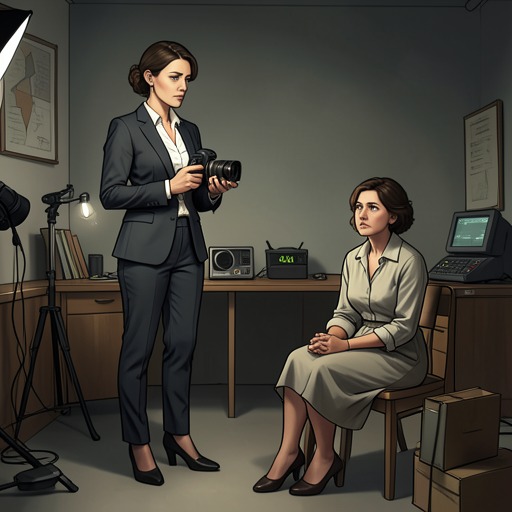
Tully's Final Girlfriend Hour Broadcast
Firefly LaneTully Hart’s final broadcast of The Girlfriend Hour is both a public health appeal and a decisive withdrawal from the career that made her famous. Rather than deliver another polished episode, she tells her audience that Kate Ryan has an aggressive, often deadly form of breast cancer, uses the program to explain its warning signs, and announces that she will take time away to be with Kate. The broadcast turns the reach and authority of Tully’s television career toward her friend’s needs, then ends with Tully leaving the stage.
A broadcast altered by private crisis
The program takes shape under the pressure of Kate’s illness. Before going on air, Tully studies herself in the makeup-room mirrors and recognizes how easily a celebrity can become absorbed in her own reflection. She refuses makeup, insisting that the audience see her as she is. This choice sets the tone for a broadcast in which the familiar performance of television gives way to an unvarnished personal disclosure.
The production itself is a substantial undertaking. Tully has changed the live show’s theme the previous afternoon, leaving producers and other staff to work late; she has stayed up until nearly two in the morning researching Kate’s illness. She has also faxed and emailed oncologists around the world and spent hours on the phone gathering information about Kate’s case. The specialists’ agreement—that nothing can be done—defines the painful limit of that work. Tully cannot turn her professional resources into a cure, but she can use the program to give the disease visibility and to educate viewers.
Naming the illness and informing viewers
Tully first addresses the audience as people who have supported her for years, acknowledging their letters, emails, and attendance at her events. She recalls an earlier broadcast on which Kate had been ambushed by Tully, a reminder that television has previously made their friendship the subject of a public spectacle. This time Tully names the stakes herself: Kate has breast cancer.
She explains that inflammatory breast cancer may begin not with a lump but with a rash or discoloration, and that it can be aggressive and deadly. Kate’s family physician had mistaken her symptoms for a bug bite and prescribed antibiotics; by the time Kate received the correct diagnosis, it was too late. Tully presents that sequence as a reason for viewers to recognize that the disease can be missed, especially in younger women, rather than as a private detail to be concealed.
The episode develops into an educational segment. A doctor appears with Merrilee Comber, a woman from Des Moines, Iowa, who first noticed a small scaly patch near her left nipple. Tully’s show names further possible signs—localized heat, discoloration, puckered skin, and inverted nipples—and urges its audience of millions to watch for breast changes as well as obtain yearly mammograms. Kate’s illness thus becomes the occasion for information that may help other women identify symptoms that a search for lumps alone could miss.
Ending the show and choosing Kate
The episode continues through interviews and images, carried by Tully’s personality, but its familiar closing formula does not arrive. Instead of her usual promise to return the next day, Tully tells viewers that Kate is her best friend and the best mother she knows, adding a warm acknowledgment of Mrs. M. She then says that this will be her last show for a long while and that she is taking time off to be with Kate. The announcement makes her departure an explicit choice: the audience and the program matter, but they do not take precedence over her friend’s need for her.
Tully gives the decision its clearest meaning when she distinguishes the show from the life beyond it. The broadcast, she says, is only a show; real life is with friends and family. She remembers that an old friend once pointed out that she does have a family, and now that family needs her. She removes her microphone, drops it to the floor, and walks off the stage. The gesture ends not only this episode but Tully’s on-air presence for an extended period, replacing the usual promise of another broadcast with an act of leave-taking.
From public performance to bedside companionship
The final broadcast is not the end of Tully’s care for Kate; it marks a shift in where that care is given. On Kate’s last night in the hospital, Tully persuades Johnny Ryan to take the children home and takes his place in the other bed in Kate’s room. She pushes the bed across the linoleum until it nearly touches Kate’s, bringing the physical distance between them as close as the hospital arrangement allows.
Tully brings a recording of the show, and the two friends watch it from their beds, laughing at the suggestion that it is what a dying woman would want to watch. The tape carries the public moment into a private room: the broadcast has told millions about Kate’s cancer, but its most intimate audience is Kate herself. The episode’s movement—from mirrors and cameras, through a national appeal, to two hospital beds pushed together—makes the final choice concrete. Tully cannot reverse Kate’s prognosis, but she can stop broadcasting, be present, and share the last night beside her friend.